


Blue Nishapur Turquoise Stone with Golden Veins
Price range: $485.00 through $685.00
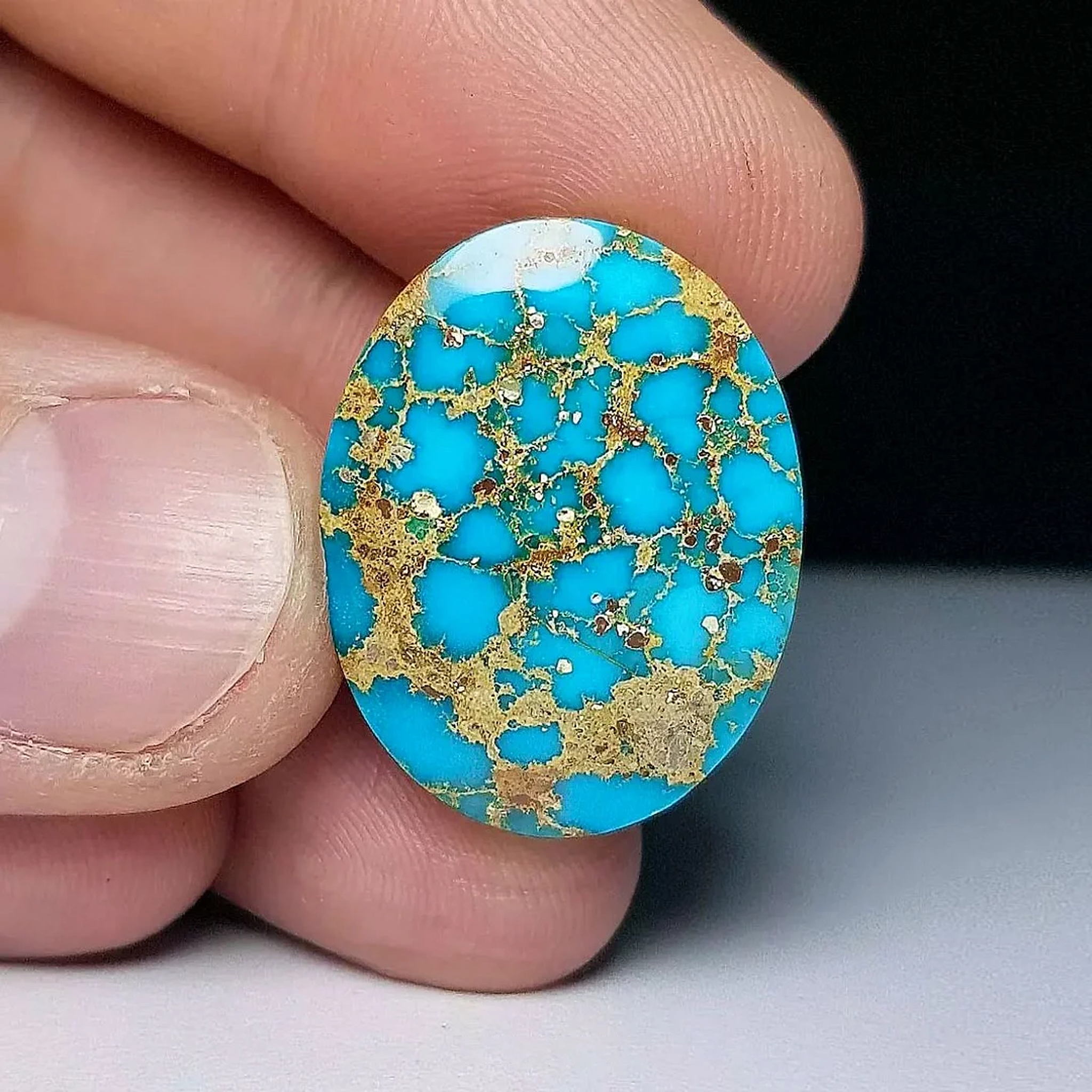
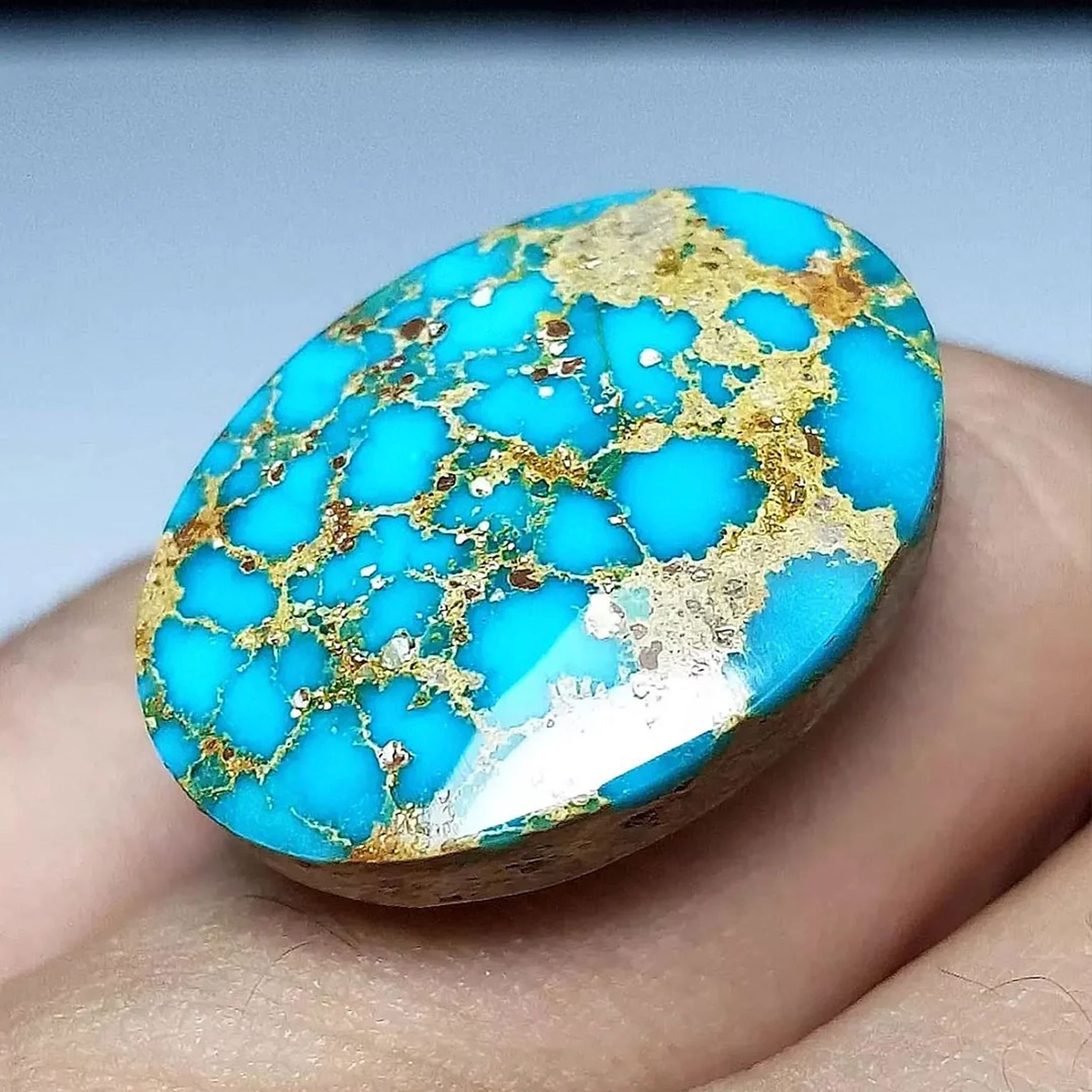
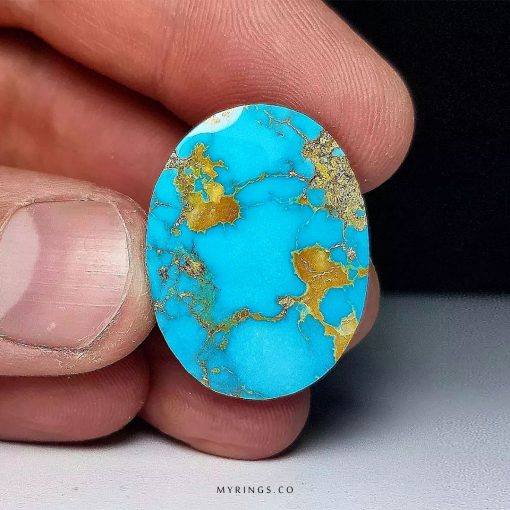
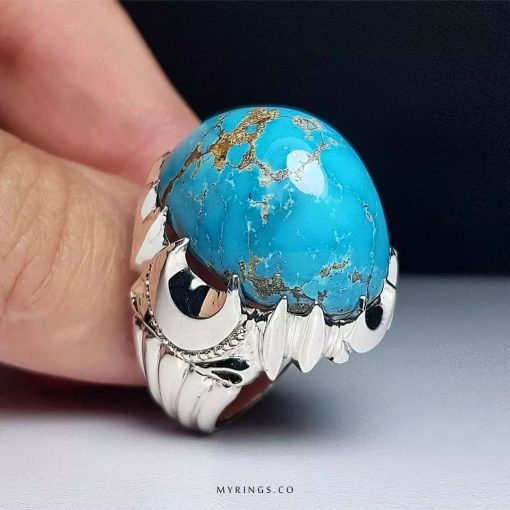
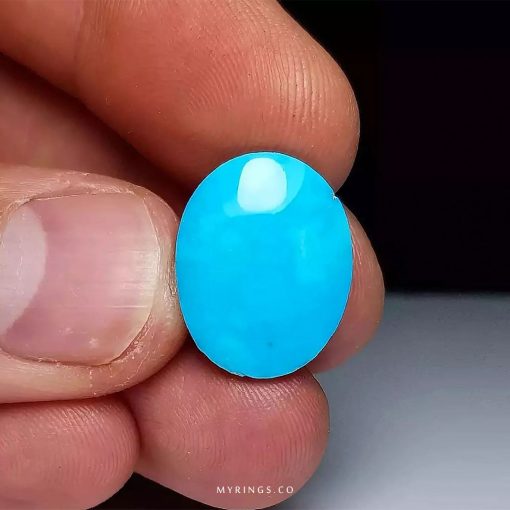
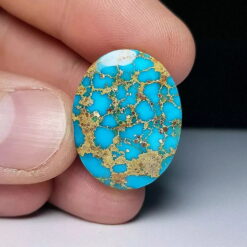
Nishapur turquoise, cut as a cabochon, with a golden matrix running across the face — the host rock the stone grew inside, not an added material.
The mines at Nishapur are the traditional source of the finest turquoise colour in the world; the gem trade calls that colour Persian blue, and applies the name to stones of that quality wherever they are found.
Nishapur and Persian Blue
Turquoise is a hydrated phosphate of copper and aluminium that forms slowly in dry, copper-bearing rock, where mineral-carrying water seeps into cracks and leaves the stone behind.
The mines at Nishapur have been worked for several thousand years, and what they produce set the world’s standard. The Gemological Institute of America puts it plainly: the traditional source of the top colour — the shade described as robin’s-egg or sky blue — is the Nishapur district. In the gem trade that colour is called Persian blue, and the name is now used for turquoise of that quality wherever it comes from. Few materials are named after the place that judged them.
Nishapur is not one colour. The mines yield sky blue, deep blue, blue-green and green, with and without matrix. What distinguishes the material is not a single shade but the range and the quality within it.
Turquoise has been set into the highest objects people have made. It is among the stones inlaid in the funerary mask of Tutankhamun, alongside lapis lazuli and carnelian, and it has been worked into thrones, weapons and vessels across the region for as long as it has been mined.
The Golden Veins
The gold-coloured lines running across this stone are not added, and they are not gold. They are the host rock the turquoise grew inside — limonite and other iron-bearing minerals left in the seams. In the trade this pattern is called matrix, and a web of it is sometimes called spiderweb turquoise.
Whether matrix is a flaw or a feature depends on who you ask. An even, unbroken blue is rarer and priced accordingly, but a stone with a clean golden web is unrepeatable in a way a plain one is not: no two patterns are alike, and buyers who want a stone nobody else has tend to look for exactly this.
Natural, Treated, and Fake
Three different things are sold as turquoise, and the difference between them is mostly a matter of price and disclosure.
Natural, untreated turquoise is the stone as it came out of the ground, cut and polished and nothing more. A great deal of what is on the market is exactly this. Where an untreated stone happens to have an even, deep colour, it is rare and priced very highly — those are the stones collectors wait for.
Treated or stabilised turquoise is real turquoise whose colour has been improved and locked in with resin or chemical treatment. It is not fake: the material is genuinely turquoise. Softer, more porous, lower-grade stone is what usually gets treated, because it needs the help — it gains a strong, even colour and stops reacting to skin oils and cosmetics. Treated stones often have very attractive colour precisely because the colour was engineered, and they cost considerably less than an untreated stone of the same appearance. Selling a treated stone as untreated natural turquoise is fraud. Selling it honestly as treated is not.
Imitation is not turquoise at all — dyed howlite, plastic, or reconstituted powder pressed into a block.
What this means for you as a buyer:
- Buy from a seller you trust, and ask directly: natural or treated? A seller who cannot answer plainly has answered.
- Be careful with a colour that looks too good for its price. An even, saturated blue on a cheap stone is usually treated. The same colour untreated would cost several times more.
- Turquoise is mined in many countries — Egypt, the United States, Kerman, China and elsewhere — and much of it looks similar to the untrained eye. Origin is one of the things you are trusting the seller on.
- Look at the matrix. Natural veining sits at different depths and changes character across the stone; printed or painted imitation is flat and repeats.
The Stone Itself
Nishapur turquoise, cut as a cabochon, with a golden matrix running across the face. It can be taken as a loose stone, or set into a ring or a pendant, with the setting made after you have chosen.
Turquoise of this kind is never uniform from one piece to the next. The depth of the colour, the width of the veining and the way the matrix falls across the face are particular to each stone, which is why we photograph them individually rather than using one image for the material as a whole.
Turquoise We Hold Now
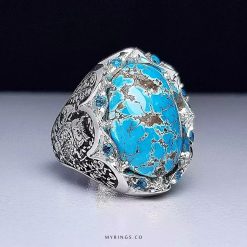
We keep two kinds of turquoise. There are finished pieces — rings already made, each around a particular stone — and there are loose stones, chosen individually, for which we will make a ring or a pendant to your size after you have picked the stone.
What we hold changes as pieces find owners.

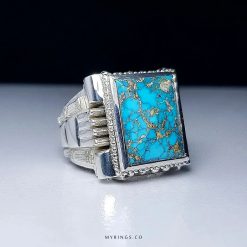
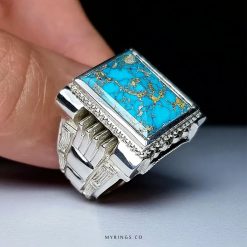
Stunning Blue Nishapur Turquoise Stone with Golden Veins MR0463
Price range: $921.00 through $1,121.00


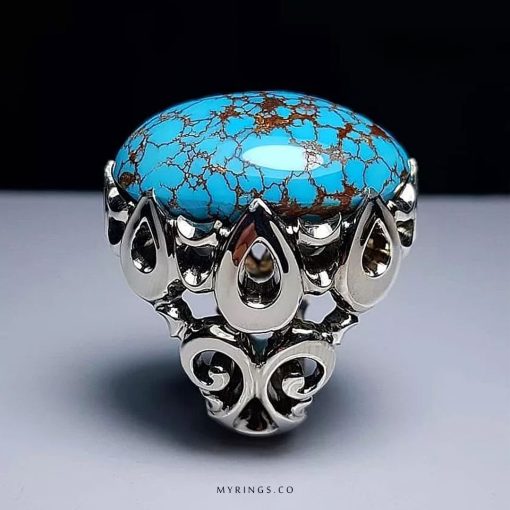
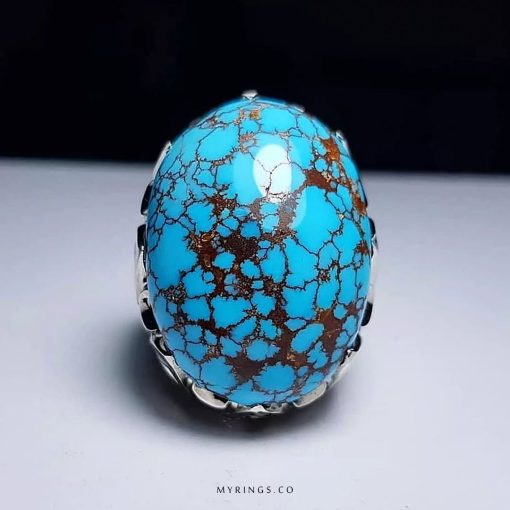
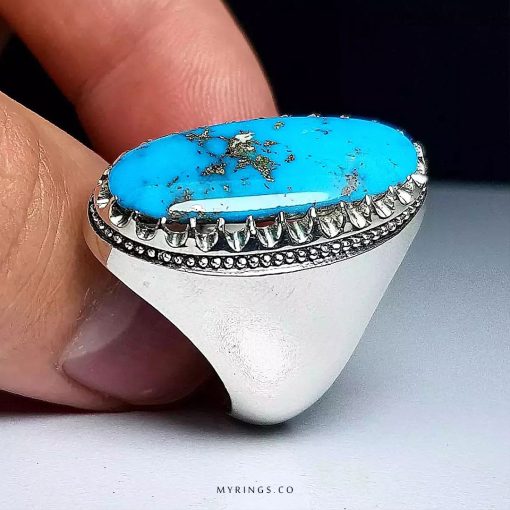



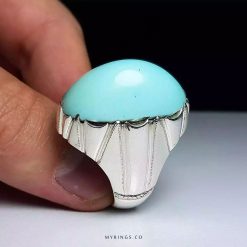
Radiant Light Blue Nishapur Turquoise – A Luxurious Gemstone Experience MR0465
Price range: $770.00 through $970.00

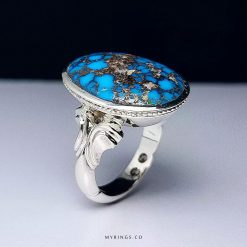
Exquisite Blue Nishapur Turquoise with Striking Black Veins – A Gemstone of Luxury MR0466
Price range: $399.00 through $595.00What the Narrations Say
Turquoise holds a particular place in Islamic tradition. It is related from Ali ibn Mahziar that he entered upon Imam Musa ibn Ja’far (a) and saw a turquoise ring on his hand engraved Lillahi’l-Mulk — to Allah belongs the dominion — and was told that this was the stone Gabriel brought to the Prophet (s) as a gift, and that the Prophet gave it to Ali (a). In that narration the stone is called al-zafar: victory. The Persian name the stone carries, pirouzeh, is the same word.
In the same body of sources, turquoise is strongly commended as a protection against the evil eye and against the ill-will of others, and keeping one on the person is held to be especially recommended. Other narrations speak of it in connection with sustenance and with protection from want.
The narrations are set out in full, with their sources, in our article on the turquoise stone.
Wearing and Care
Turquoise is softer than quartz and porous, which makes it easier to mark than it looks. Keep it away from perfume, hand cream, household cleaners and hot water, take it off before swimming, and never put it in an ultrasonic cleaner. A wipe with a soft dry cloth is all it asks for.
Worn properly, a natural stone tends to improve. Over years on the hand the colour usually deepens rather than fades, and after several years of steady wear it settles: the stone reaches a colour of its own and holds it. Many wearers prefer a stone that has been lived with to one straight from the bench, and this is why.
A fuller guide to keeping turquoise is on our blog.
Related products






Reviews
Clear filtersThere are no reviews yet.